Petrified Forest National Park
Where Dinosaurs Once Roamed
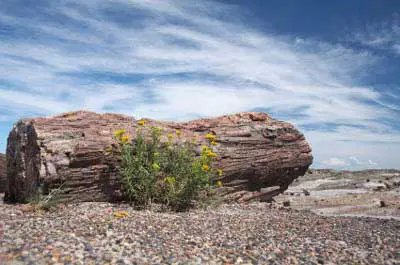
Imagine walking back through time in a place where dinosaurs once roamed over 225 million years ago. A time when lush green forests ruled the landscape with 200 foot tall conifers. Volcanic mountains erupted toppling the trees. Swept away by waterways and covered with volcanic ash and sediment, these trees became entombed and over millions of years became petrified. Through gradual erosion, gigantic logs and remnant pieces became exposed for the world to experience.
Arizona's Petrified Forest
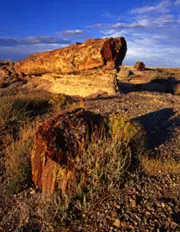
The Arizona Petrified Forest National Park is located in the northeastern part of Arizona about 25 miles east of Holbrook, Arizona. It is a fascinating place to visit abundant with geographical history. The Painted Desert is adjacent to the Petrified Forest, so it is a great opportunity to visit both historical sites in a single trip.
Some visitors expect to see green forests that once stood but instead find stone logs and log fragments in what otherwise is a featureless section of Arizona desert. However, thick pine forests and cool mountain country is within relatively close driving distance in Flagstaff and the White Mountains area of Arizona.
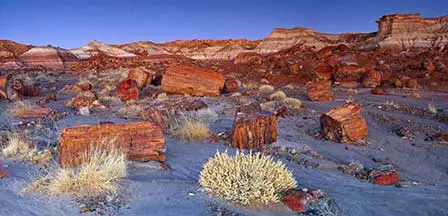
The Petrified Forest is home to some of the most impressive fossils ever found and more are being discovered each year as erosion exposes new evidence. Fossils found here show the Forest was once a tropical region, filled with towering trees and extraordinary creatures we can only imagine. While more than 150 different species of fossilized plants have been discovered by paleontologists, species of reptiles, such as Desmatosuchus, similar to the armadillo, have also been discovered.
Archaeologists have found much evidence to indicate that ancient native people inhabited this region about 10,000 years ago. Petroglyph drawings on rock surfaces, gives a glimpse of the past and you can see the marks of a solar calendar at Puerco Pueblo near the time of the summer solstice.
How Petrified Wood Was Formed
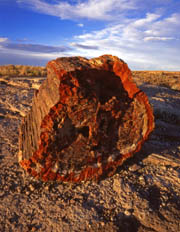
When trees were toppled by volcanic eruptions, they were swept away by flowing water and deposited in marshes and covered with mud and volcanic ash. Buried under layers of sediment, the logs remained buried for millions and millions of years undergoing a extremely slow process of petrification which essentially turned the logs to colorful stone.
The area became covered with an ocean covering the logs with even more sediment. About 60 million years ago the ocean disappeared and was replaced with flowing rivers that gradually eroded over 2,600 feet of sediment depth slowly exposing the petrified wood that litters the landscape at the Petrified Forest National Park. There is no doubt that millions of pounds of petrified logs still remain buried deep into the ground. Eventually gradual and continuing erosion will expose even more stone logs that are still entombed.
The petrification process began with tree burial. The volcanic ash and mud released chemicals during decomposition. The chemicals reacted with wood to form quartz crystals which by themselves are colorless. Minerals in the water such as iron or manganese gave the quartz red and pinkish hues. Over millions of years, the quartz crystals "cocooned" the logs slowly turning them to stone.
Petrified Forest Video
Four Main Areas of Petrification
The park has four main areas of petrification: Blue Mesa, Jasper Forest, Crystal Forest and Rainbow Forest.
Blue Mesa is named after the bluish-gray mounds of clay the logs rest in. As the clay erodes away, more logs are revealed. A short road takes you to the Blue Mesa however the soil is delicate so there are no trails in this spot.
Jasper Forest is also off limits for hiking. Jasper Forest occupies a large barren valley but has numerous logs scattered all over. Unfortunately, this spot was once popular with early collectors and prospectors who hauled off logs by the cartload. Follow a short road to view the Agate Bridge, a complete log spanning a dry creek bed.
The Crystal Forest is so named because many of the logs found here contained clear quartz and purple amethyst crystals making for beautiful logs. Unfortunately, souvenir hunters helped themselves long ago, taking the best samples away. A few crystallized logs remain but the more typical petrified logs are more abundant. The disappearance of the crystal logs led to the area's ultimate protection as a National Monument in 1906 and finally a National Park in 1962.
The Rainbow Forest is located at the south end of the park. This section is abundant and dense with petrified logs. It is also where you'll find the museum. Several trails wind through this section taking you to the Giant Forest where you'll find the largest logs. Take the Long Logs Trail to see hundreds of spectacular, colorful specimens. Be sure to check out the Agate House, a petrified log hut built by 16th century Indians.
In addition to petrified logs, the Petrified Forest offers petroglyphs, Painted Desert scenery and archaeological sites and ruins. Summertime temperatures usually average in the 90s and the winters are generally mild with afternoon temperatures in the 40s. The park is open year round with the exception of Christmas Day.
Hiking In The Park
You'll find many hiking trails within both the Petrified Forest and Painted Desert. You will discover many viewpoints where you'll want to stop to view the scenery including Kachina Point, Chinde Point, the Puerco Indian Ruins, Newspaper Rock, the Tepees, Blue Mesa, Jasper Forest Overlook, Crystal Forest, and the Flattops. On the trail through Giant Logs, you'll find the Rainbow Forest Museum.
Don't Steal Petrified Wood
Over time, visitors have removed precious samples. Park officials estimated that 12 to 15 tons are lost every year due to visitor theft. Don't be tempted to pilfer pieces of the ancient treasures because there are stiff fines and penalties applied to violators. It is a tough "no-tolerance" policy. Officials also warn visitors of an alleged curse that bestows bad luck to thieves of petrified wood.
Getting To The Petrified Forest
Entrance to the park is about 25 miles east of Holbrook AZ. Take Exit 311 from Interstate 40 to US 180. A 27 mile road runs through the Petrified Forest. The Visitor Center is at the north end of the Park. From I40, the road travels nine miles through the Painted Desert.
The Park is open all year from 8:00 AM to 5:00 PM except Christmas Day.
*Hours subject to change.
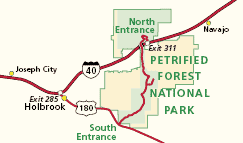
Area Map of Petrified Forest National Park. Petrified Forest National Park stretches north and south between Interstate 40 and Highway 180.
Nearby Cities, Towns & Destinations
Holbrook Arizona: 25 miles west of the Park.
Flagstaff Arizona: 95 miles west of the Park.
Show Low Arizona: 62 miles south of the Park
Gallup New Mexico: 66 miles east of the Park
Albuquerque New Mexico: 204 miles east of the Park.
Phoenix Arizona: About 3.5 hour drive.
Helpful Tourist Information
Petrified Forest National Park
Forest & Painted Desert Photos
Related Painted Desert Interest
Painted Desert
Magic In The Painted Desert
Ancient People Petrified Forest
Map & Directions Petrified Forest
Petrified Forest Painted Desert Photos
Petrified Forest