

How Hoover Dam Was Built
Reviewed and updated by AZ Leisure Staff Writers on .
Building Hoover Dam required engineers and thousands of workers to reshape Black Canyon, divert the Colorado River and place more than 3.25 million cubic yards of concrete in the dam itself. Construction began during the Great Depression and combined enormous diversion tunnels, high scalers working on canyon walls, aerial cableways, specially designed concrete blocks and an artificial cooling system using hundreds of miles of embedded pipe. The result was one of the defining American engineering achievements of the 20th century.
- Hoover Dam Construction Timeline
- Six Companies & The Construction Contract
- Workers During The Great Depression
- Diverting The Colorado River
- Preparing Black Canyon
- Pouring The Concrete
- Cooling Hoover Dam
- How The Dam Works
- Hoover Dam Or Boulder Dam?
- Hoover Dam Construction FAQ
Hoover Dam Construction Timeline
- March 1931: Six Companies, Inc. was awarded the major construction contract
- April 20, 1931: The contractor received official notice to proceed
- May 1931: Excavation of the Colorado River diversion tunnels began
- November 14, 1932: The Colorado River was diverted through the Arizona tunnels
- June 6, 1933: The first concrete was placed in Hoover Dam
- February 1, 1935: Lake Mead began filling behind the dam
- May 29, 1935: The last concrete was placed in the dam
- September 30, 1935: President Franklin D. Roosevelt dedicated the dam
- March 1, 1936: All major project features were completed
Six Companies & The Hoover Dam Construction Contract
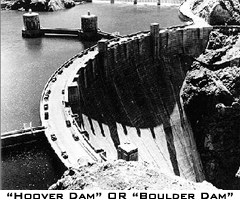
The Hoover Dam project was too large for most individual construction companies of the era to undertake alone. Six major western contractors joined forces to create Six Companies, Inc., which submitted the successful bid to build the dam and related works.
Six Companies bid $48,890,995 for the construction contract. The contractor was allowed seven years from April 20, 1931, to complete the dam, powerplant and associated works, but major project features were finished by March 1, 1936—well ahead of the contractual deadline.
Hoover Dam Workers During The Great Depression
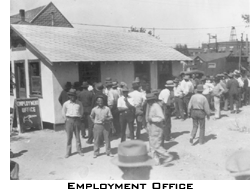
The Hoover Dam project became a powerful draw for unemployed Americans during the Great Depression. Men traveled from across the country hoping to secure construction work, and many brought wives, children and nearly everything they owned.
Approximately 21,000 men worked on the project over the course of construction. The average workforce was about 3,500, and employment peaked at 5,218 workers in June 1934. Families initially endured difficult living conditions in temporary settlements before Boulder City provided more permanent housing and services.
Employment opportunities were not equal. Black workers faced severe racial discrimination and represented only a very small portion of the workforce. For the fuller human story, see Who Built Hoover Dam?.
Diverting The Colorado River

Before construction could begin in the river channel, engineers had to move the Colorado River around the future Hoover Dam site. Four massive diversion tunnels were excavated through Black Canyon—two on the Arizona side and two on the Nevada side.
The tunnels were excavated to about 56 feet in diameter and lined with three feet of concrete, leaving a finished diameter of approximately 50 feet. Together they extended 15,946 feet, or about three miles. The Colorado River was first diverted through the two Arizona tunnels on November 14, 1932.
See our detailed guide to the Hoover Dam Diversion Tunnels for the full drilling, blasting and river-diversion story.
Preparing Black Canyon For Hoover Dam
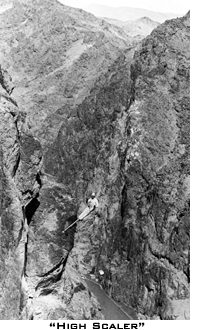
Construction required more than excavating the riverbed. Loose and unstable rock also had to be removed from the steep walls of Black Canyon so Hoover Dam could be anchored securely against sound rock.
Specialized workers known as high scalers descended the canyon walls on ropes carrying drills, pry bars and explosives. They removed unstable rock and prepared the Arizona and Nevada canyon walls while other construction crews worked hundreds of feet below.
Learn more about this dangerous work in our Hoover Dam High Scalers history.
Pouring The Concrete For Hoover Dam
The dam itself contains approximately 3.25 million cubic yards of concrete, while Hoover Dam and its associated structures required approximately 4.4 million cubic yards in total. The first concrete in the dam was placed on June 6, 1933, and the last was placed on May 29, 1935.
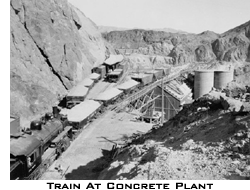
Concrete could not simply be poured as one enormous mass. Hoover Dam was constructed as approximately 215 interlocking vertical blocks or columns. These varied from about 60 feet square at the upstream face to about 25 feet square at the downstream face, and concrete placement in any one block was limited to five feet in 72 hours.
Large buckets transported concrete from the mixing plants to aerial cableways spanning Black Canyon. The cableways then carried the buckets out over the construction site and lowered concrete to crews working far below.
How Engineers Cooled Hoover Dam's Concrete
Concrete generates heat as it cures. If Hoover Dam had been poured as one massive block and left to cool naturally, the enormous temperature differences could have caused damaging cracks and delayed completion for many decades.
Engineers solved the problem by embedding more than 582 miles of one-inch steel pipe throughout the concrete. Ice water circulated through these pipes to carry away the heat generated during curing.
A refrigeration plant supplied the chilled water and had the capacity to produce the equivalent of approximately 1,000 tons of ice every 24 hours. Cooling of the dam was completed in March 1935. After the concrete cooled and contracted, grout was forced into spaces between the blocks to form a unified structure.
How Hoover Dam's Arch-Gravity Design Works
Hoover Dam is a concrete thick-arch structure. Its enormous mass resists the force of Lake Mead through gravity, while its curved upstream face also transfers part of the reservoir load outward into the strong rock walls of Black Canyon.
The combination of mass, curvature and solid canyon foundations allows the structure to withstand the tremendous water pressure created by Lake Mead while supporting the intake, power-generation and water-control systems associated with the dam.
Hoover Dam Or Boulder Dam?
The project's naming history reflects both its early planning and American politics. Although early plans focused on Boulder Canyon, engineers ultimately selected Black Canyon as the dam site.
In September 1930, Secretary of the Interior Ray Lyman Wilbur announced that the new dam would be called Hoover Dam in honor of President Herbert Hoover, and Congress made the name official in 1931. During the Franklin D. Roosevelt administration the structure was commonly called Boulder Dam. Congress officially restored the name Hoover Dam in 1947, and that name has remained ever since.
Completing Hoover Dam
The contract allowed seven years for construction of the dam, powerplant and associated works, but the project moved considerably faster. Concrete placement in the dam ended on May 29, 1935, President Franklin D. Roosevelt dedicated the project on September 30, 1935, and all major construction features were completed by March 1, 1936.
Hoover Dam remains a working federal water and power facility as well as a landmark in American engineering history. For original construction imagery, visit our Hoover Dam Historic Photo Gallery.
Hoover Dam Construction FAQ
When was Hoover Dam built?
Major construction began in 1931. The first concrete in the dam was placed June 6, 1933, the last concrete was placed May 29, 1935, and all major project features were completed by March 1, 1936.
Who built Hoover Dam?
The major construction contract was awarded to Six Companies, Inc., a consortium of western construction firms. Approximately 21,000 men worked on the project over the course of construction.
How much did the Hoover Dam construction contract cost?
Six Companies submitted the successful construction bid of $48,890,995 for the principal Hoover Dam contract.
How was the Colorado River moved while Hoover Dam was built?
Four large diversion tunnels were excavated through Black Canyon. The Colorado River was first redirected through the two Arizona tunnels on November 14, 1932.
How much concrete is in Hoover Dam?
The dam itself contains approximately 3.25 million cubic yards of concrete. Hoover Dam and its associated structures contain approximately 4.4 million cubic yards in total.
Was Hoover Dam poured as one solid block?
No. Hoover Dam was constructed as approximately 215 interlocking vertical concrete blocks or columns. Concrete placement in each block was carefully controlled to manage heat and curing.
How was the concrete in Hoover Dam cooled?
More than 582 miles of one-inch steel pipe were embedded in the concrete. Ice water circulated through the pipes to remove heat generated as the concrete cured.
How much ice could the Hoover Dam refrigeration plant produce?
The refrigeration plant had cooling capacity equivalent to approximately 1,000 tons of ice every 24 hours.
What did Hoover Dam high scalers do?
High scalers worked suspended by ropes on the walls of Black Canyon, removing loose rock and helping prepare solid surfaces where the dam and related structures could be anchored.
Was Hoover Dam completed ahead of schedule?
Yes. The contractor was allowed seven years from April 20, 1931, but all major project features were completed by March 1, 1936.
For detailed information, use the navigation below to access interesting insight into the building history of Hoover Dam.
Historic photographs courtesy of the Boulder City/Hoover Dam Museum.
Related Hoover Dam Interest
Hoover Dam
Building Hoover Dam
Hoover Dam Diversion Tunnels
Hoover Dam High Scalers
Hoover Dam Historic Photos
Hoover Dam Map
Hoover Dam Men
Hoover Dam Pictures
Along The Colorado River
Colorado River Lakes
Lake Powell
Lake Mead
Lake Mohave
Lake Havasu