

Brief History of Route 66
Last updated on .
America’s Main Street
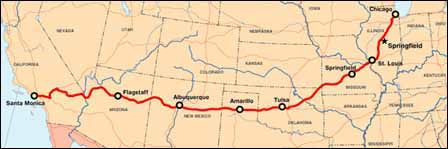
The history of U.S. Route 66 is deeply woven into the story of America, symbolizing freedom, opportunity, and the spirit of the open road. Established in 1926 as part of the nation’s first highway system, Route 66 stretched more than 2,400 miles from Chicago to Santa Monica, connecting eight states and hundreds of communities along the way. Known as the “Mother Road,” it played a vital role during the Great Depression, serving as a major route for westward migration and economic growth, and later became a cornerstone of American road trip culture before being officially decommissioned in 1985.
The basic path that Route 66 would take was cultivated in the very early 1800s, when American pioneers were beckoned westward into unsettled areas. In pursuit of adventure, land ownership and the riches of gold and silver, the pioneers went west of the Mississippi eventually penetrating all the way to the Pacific Ocean. Traveling by horseback and wagon train they forged trails that became corridors for others to follow.
Major Attractions Along Route 66
Today, Route 66 remains one of the most iconic travel routes in the United States, attracting visitors with its nostalgic roadside attractions, historic towns, and unique landmarks. Travelers can explore classic diners, vintage motels, quirky roadside stops, and cultural landmarks across states like Missouri, Oklahoma, Texas, New Mexico, Arizona, and California. Famous attractions include the Gateway Arch, Cadillac Ranch, Petrified Forest National Park, and the iconic Santa Monica Pier at the western end of the route. These destinations, along with countless small-town stops and scenic desert landscapes, make Route 66 a living museum of American history and culture.
Along the way to new territories, boomtowns sprouted and soon the wild west period was in full-throttle. Railroads eventually were built alongside the dusty trails enabling greater migration and development of commerce routes. Still, travel via horse and wagon was slow and grueling along unimproved dirt trails.
Invented in 1908, the Ford “horseless carriage” would change the face of travel. Gradually, the primitive trails were graded and graveled relatively smoothly as the evolution of the automobile “un-tethered American travel”.
Championed by Oklahoma businessman Cyrus Avery, talks began in 1923 to create a standardized national highway system of paved two-lane roads. Thus, Route 66 came to be in 1926 connecting Chicago to Los Angeles through small-town midwestern and western America. Although some stretches were not completely paved until 1938, Route 66 unleashed both pleasure and relocation travel.
The path of Route 66 actually followed many of the trails originally forged by exploring pioneers in the early 1800s. Intentionally Route 66 was not a straight highway but zigzagged across the Midwest, the Plains and the Southwest on its way to Santa Monica on the Pacific Coast. Routes were designed to connect small towns in a pattern that focused on relatively flat terrain through areas of favorable weather.
Best Route 66 USA Destinations
- Chicago – Historic eastern starting point of Route 66
- St. Louis – Gateway Arch and classic Route 66 attractions
- Oklahoma City – Rich Route 66 heritage and museums
- Amarillo – Home of the famous Cadillac Ranch
- Albuquerque – Historic Old Town and vibrant culture
- Flagstaff – Mountain scenery and preserved Route 66 sections
- Santa Monica – Iconic western endpoint at the Pacific Ocean
Route 66 spawned rapid growth westward giving rise of small towns into major U.S. cities including Oklahoma City and Albuquerque. The brisk growth of tourism spawned motels, curio shops, filling stations and bazaar roadside attractions. Route 66 changed the travel landscape and cemented its reputation as a microcosm of the cultures of America linked by the automobile.
Somewhat sadly with the modern evolution of multi-lane Interstate Freeway systems, Route 66 (officially U.S. 66) was decommissioned in 1985 giving way to “straight-shot” freeways permitting greater speed and shortened distances between larger towns and cities leaving quaint small towns off the beaten path.
Substantially, the freeways followed the basic path of Route 66 and there still remains short stretches of old Route 66 that stray from the Interstate highways. Along those historical stretches, travelers can still experience the nostalgia, historical landmarks and some roadside attractions.
So…Route 66 is not totally gone. Its winding and cracked road is alive and well in many places including the longest stretch of Route 66 which flows through Northern Arizona.
Related Route 66 Interest
Arizona Route 66
Route 66 Arizona Stretch
Route 66 History
Most Popular Things To Do In AZ
Additional Arizona Activities