
Route 66 History, Facts & The Story Of The Mother Road
Updated by AZ Leisure Staff Writers on

U.S. Route 66 became one of the most famous highways in American history, linking Chicago with the West and helping shape automobile travel, migration, roadside commerce and popular culture. Established in 1926 as part of the original U.S. Highway System, Route 66 originally ended in Los Angeles and was later extended to Santa Monica. Known as the “Mother Road,” the highway crossed eight states and became an enduring symbol of freedom, opportunity and the American road trip before being officially removed from the U.S. Highway System in 1985.
- Route 66 Overview
- Route 66 Timeline
- The Mother Road
- Major Attractions
- States Along Route 66
- Best Route 66 Destinations
- Decommissioning Route 66
- Legacy & Cultural Impact
- FAQ
Historic Route 66 Overview
Why Route 66 Became The Mother Road
Route 66 became famous because it connected large cities, small towns, agricultural regions and western destinations at a time when automobile travel was transforming American life. During the Great Depression it became an important migration corridor for families heading west, and in the decades that followed it supported thousands of motels, diners, service stations, tourist courts and roadside attractions. Its importance to migration and American culture helped inspire the enduring nickname “Mother Road.”
Long before Route 66 was numbered, westward migration, wagon roads, railroads and regional automobile routes helped establish transportation corridors across the Midwest, Great Plains and Southwest. As automobile ownership increased during the early 20th century, pressure grew for a standardized network of dependable interstate highways connecting cities and rural communities.
Route 66 History Timeline
- 1926: U.S. Route 66 is established as part of the original federal highway system, connecting Chicago with Los Angeles.
- 1930s: Route 66 becomes an important westward migration corridor during the Great Depression.
- 1936: The western terminus is extended from Los Angeles to Santa Monica.
- 1938: Route 66 becomes fully paved from Chicago to California.
- 1940s: Wartime travel and military transportation increase traffic along portions of the highway.
- 1950s: Postwar tourism helps create the classic Route 66 culture of motels, diners, neon signs and roadside attractions.
- 1956: The Interstate Highway System begins gradually replacing Route 66 as a major through-route.
- 1985: U.S. Route 66 is officially removed from the federal highway system.
- Today: Many surviving sections are preserved and promoted as Historic Route 66.
Major Attractions Along Historic Route 66
Today, Route 66 remains one of the most iconic travel routes in the United States, attracting visitors with its nostalgic roadside attractions, historic towns, and unique landmarks. Travelers can explore classic diners, vintage motels, quirky roadside stops, and cultural landmarks across states like Missouri, Oklahoma, Texas, New Mexico, Arizona, and California. Famous attractions include the Gateway Arch, Cadillac Ranch, Petrified Forest National Park, and the iconic Santa Monica Pier at the western end of the route. These destinations, along with countless small-town stops and scenic desert landscapes, make Route 66 a living museum of American history and culture.
Along the way to new territories, boomtowns sprouted and soon the wild west period was in full-throttle. Railroads eventually were built alongside the dusty trails enabling greater migration and development of commerce routes. Still, travel via horse and wagon was slow and grueling along unimproved dirt trails.
Ford introduced the Model T in 1908, helping make automobile ownership practical for a growing number of Americans. As cars became more common, demand increased for improved roads, standardized highway signs and dependable long-distance routes. Dirt and gravel roads were gradually improved, creating the foundation for a national highway network.
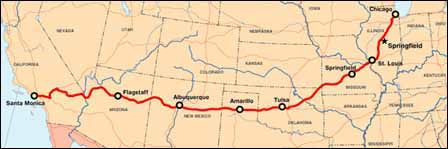
Oklahoma highway advocate Cyrus Avery played an important role in planning and promoting the route that became U.S. 66. When the federal highway system was established in 1926, Route 66 connected Chicago with Los Angeles through Illinois, Missouri, Kansas, Oklahoma, Texas, New Mexico, Arizona and California. The highway was gradually improved and was fully paved by 1938.
Route 66 incorporated and connected portions of earlier roads and regional automobile routes rather than following one single historic trail. Its alignment was designed to link established communities while providing a practical east-west transportation corridor across the Midwest, Great Plains and Southwest.
Eight States Along Historic Route 66
- Illinois: Route 66 begins in Chicago and travels southwest through communities such as Joliet and Springfield.
- Missouri: The highway crosses St. Louis and continues through the Ozarks toward southwestern Missouri.
- Kansas: Route 66 passes through a short section of southeastern Kansas.
- Oklahoma: Historic Route 66 crosses much of the state through communities including Tulsa and Oklahoma City.
- Texas: The route crosses the Texas Panhandle through Amarillo and surrounding plains.
- New Mexico: Route 66 crosses desert and high-desert landscapes through cities including Albuquerque.
- Arizona: Historic sections pass through communities including Holbrook, Winslow, Flagstaff, Williams, Seligman and Kingman.
- California: Route 66 crosses the Mojave Desert before reaching the Los Angeles area and Santa Monica.
Best Route 66 USA Destinations
- Chicago – Historic eastern starting point of Route 66
- St. Louis – Major Missouri gateway along the historic route
- Oklahoma City – Route 66 museums, neighborhoods and roadside history
- Amarillo – Texas Panhandle stop known for Cadillac Ranch and Route 66 heritage
- Albuquerque – Historic Route 66 architecture, neon signs and New Mexico culture
- Flagstaff – Historic Route 66 through a scenic Northern Arizona mountain community
- Williams – Preserved Route 66 downtown and gateway to the Grand Canyon
- Santa Monica – Celebrated western endpoint of the historic highway at the Pacific Ocean
Route 66 accelerated automobile tourism and roadside commerce in communities along its path. Motels, tourist courts, diners, filling stations, souvenir shops and distinctive roadside attractions developed to serve the growing number of motorists, creating a travel culture that became closely associated with the highway.
Why Route 66 Was Decommissioned
Route 66 gradually lost its role as a major national highway after construction of the Interstate Highway System began in the 1950s. New controlled-access freeways provided faster travel and bypassed many towns, businesses and older highway alignments that had depended on Route 66 traffic.
U.S. Route 66 was officially removed from the federal highway system in 1985. The road itself did not disappear, however. Many surviving sections became state highways, local roads or designated Historic Route 66 routes, preserving large portions of the Mother Road for modern travelers.
Some of the most celebrated surviving stretches are in Northern Arizona, where travelers can still experience historic towns, roadside businesses and long sections of old Route 66.
Route 66 Legacy & Cultural Impact
Route 66 helped define the American road trip and influenced generations of roadside architecture, tourism and popular culture. Motels, diners, neon signs, gas stations and unusual roadside attractions became recognizable symbols of highway travel. The Mother Road later became celebrated in literature, television, music, movies and advertising, helping preserve Route 66 as an international symbol of freedom, exploration and classic Americana.
Route 66 History FAQ
When Was Route 66 Established?
U.S. Route 66 was established in 1926 as part of the original numbered U.S. Highway System.
Where Did Route 66 Originally Begin And End?
Route 66 began in Chicago, Illinois, and originally ended in Los Angeles, California. Its western terminus was later extended to Santa Monica.
How Long Was Route 66?
The historic highway extended for roughly 2,400 miles across eight states, although its exact mileage changed as the route was realigned over the years.
Which States Did Route 66 Pass Through?
Route 66 crossed Illinois, Missouri, Kansas, Oklahoma, Texas, New Mexico, Arizona and California.
Why Is Route 66 Called The Mother Road?
The nickname “Mother Road” was popularized by John Steinbeck in his novel The Grapes of Wrath, which portrayed the highway as an important route for families migrating west during the Great Depression.
When Was Route 66 Fully Paved?
Route 66 became fully paved in 1938, making it one of the nation's major continuous paved routes between the Midwest and California.
When Was Route 66 Decommissioned?
Route 66 was officially removed from the U.S. Highway System in 1985 after Interstate highways had replaced it as a major long-distance transportation route.
Can You Still Drive Route 66 Today?
Yes. Many sections of historic Route 66 remain drivable as state highways, local roads and designated Historic Route 66 routes, although the original highway no longer exists as one continuous federally designated route.
Where Are Some Of The Best Preserved Sections Of Route 66?
Historic sections survive throughout the eight Route 66 states. Northern Arizona is especially well known for long preserved stretches through communities such as Flagstaff, Williams, Seligman and Kingman.
Why Is Route 66 Still Famous?
Route 66 remains famous for its role in American migration, automobile travel, roadside culture and tourism. Its historic towns, neon signs, diners, motels and roadside attractions continue to attract travelers from around the world.
Related Route 66 Interest
Arizona Route 66 Attractions
Historic Route 66 Through Arizona
Flagstaff Arizona
Williams Arizona
Most Popular Things To Do In AZ
Additional Arizona Activities