
History of Tombstone AZ
When prospector Ed Schieffelin first set out to find his fortune in 1877 Arizona, soldiers at nearby Fort Huachuca warned that he was more likely to find his own tombstone than silver in the dangerous and remote countryside. When he struck rich silver ore later that year, Schieffelin named his mining claim Tombstone, a tongue-in-cheek reference to the warning he had received. His discovery helped trigger the silver boom that soon transformed the area into one of Arizona Territory's most famous mining towns.
Tombstone Became A Boom Town
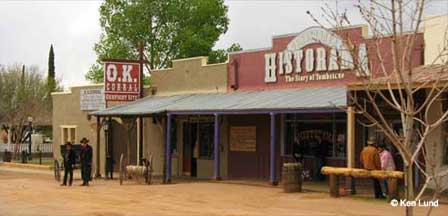
The town of Tombstone quickly followed the boom of silver claims in 1879, bringing prospectors and business owners looking to strike it rich along with Schieffelin. And rich they became. Wealth flowed out of the hills like water from a mountain stream, and within only a few years Tombstone's population had grown into the thousands. By 1881, historical estimates place the population at roughly 6,000 to 7,000. The town flourished, with housing, hotels, stores, theaters, numerous saloons and gambling halls constructed to serve the rapidly growing population.
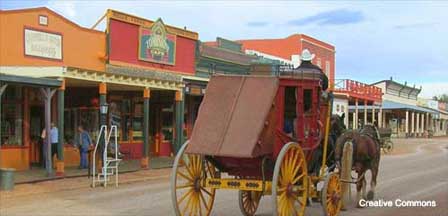
With the people came the need for modern conveniences and Tombstone, despite its isolated location, became a bustling community with piped water, telegraph service and major investments from U.S. businessmen. There was even a roller-skating rink, one of several forms of entertainment available to residents of the growing town. Immigrants from Europe and Chinese residents were also part of Tombstone's diverse population, working in mining, businesses, laundries, hotels and other trades that supported the rapidly expanding community.
Rowdy Cowboys and Outlaws
While mining brought Tombstone its wealth, southeastern Arizona also attracted cattle rustlers, stagecoach robbers and other outlaws who took advantage of the region's remote location and proximity to the Mexican border. Conflicts between these groups and local lawmen became part of Tombstone's growing reputation for violence. Virgil Earp became Tombstone marshal, while his brothers Wyatt and Morgan also served in law-enforcement roles. Their friend, dentist-turned-gambler John "Doc" Holliday, became closely associated with the Earps. The continuing conflict between the Earps and members and associates of the Clanton and McLaury families culminated in the legendary Gunfight near the O.K. Corral on October 26, 1881. The confrontation helped cement Tombstone's place in Old West history. Be sure to visit Boothill Graveyard, the historic cemetery where outlaws, miners and other early Tombstone residents are buried.
Tombstone's Fall From Grace
Like so many boomtowns, Tombstone's rapid rise was followed by economic decline. The town suffered major fires in 1881 and again in 1882, with the second destroying much of the central business district. Tombstone rebuilt and prosperity continued for a time, but falling silver prices and labor disputes soon placed pressure on the mining industry. In 1886, underground water overwhelmed the mines despite efforts to pump them dry, forcing major operations to close. Much of the population departed, and Tombstone began its long decline from prosperous mining center to a much smaller community.
Today Tombstone Thrives As A Historic Destination
Tombstone never disappeared completely. Mining returned periodically, but over time the community increasingly turned to preservation and tourism. During the twentieth century, residents restored historic buildings and embraced the Old West heritage that had made Tombstone famous. Today the town's museums, historic sites, reenactments and preserved frontier streets attract hundreds of thousands of visitors each year, keeping alive the story of one of Arizona's most legendary mining towns.
Tombstone Arizona History FAQ
Who founded Tombstone Arizona?
Prospector Ed Schieffelin discovered rich silver ore in southeastern Arizona in 1877. His discovery led to the mining boom and settlement that became Tombstone.
How did Tombstone Arizona get its name?
According to the traditional account, soldiers at Fort Huachuca warned Ed Schieffelin that prospecting in the dangerous countryside would earn him only his tombstone. After discovering silver, he used Tombstone as the name of his mining claim.
When did Tombstone become a boomtown?
Tombstone grew rapidly after silver discoveries beginning in 1877. The town was established in 1879 and by 1881 had become one of the largest and most prosperous communities in Arizona Territory.
What happened at the O.K. Corral?
On October 26, 1881, Virgil, Wyatt and Morgan Earp and Doc Holliday confronted members and associates of the Clanton and McLaury families near the O.K. Corral. Billy Clanton, Tom McLaury and Frank McLaury were killed, while Virgil and Morgan Earp were wounded.
Why did Tombstone's mining boom end?
Tombstone's decline resulted from several factors, including falling silver prices, labor disputes and serious groundwater problems in the mines. In 1886, flooding overwhelmed major mining operations and much of the population left town.
Did Tombstone become a ghost town?
No. Although its population declined dramatically after the mining boom, Tombstone survived and later developed a new economy centered on historic preservation and tourism.
Related Tombstone Interest
Tombstone Arizona
Bird Cage Theatre
Gunfight At The OK Corral
Tombstone History
Southern Arizona Destinations