
How Kartchner Caverns Were Formed
Updated by AZ Leisure Staff Writers on
Kartchner Caverns began with limestone deposited beneath a shallow inland sea approximately 330 million years ago. Millions of years later, uplift and faulting helped form southeastern Arizona's Whetstone Mountains while a block of limestone dropped thousands of feet relative to the peaks above. Slightly acidic rainwater then seeped through fractures in the buried limestone, slowly dissolving underground passages and chambers. After groundwater levels fell and the rooms filled with air, mineral-rich water began creating the stalactites, stalagmites, columns, flowstone and other speleothems that continue to grow inside Kartchner Caverns today.
- How Kartchner Caverns Formed
- Escabrosa Limestone
- How Water Created The Cave
- How Speleothems Grow
- Types Of Cave Formations
- Colors & Minerals
- Why Kartchner Is A Living Cave
- Scientific Research
- Kartchner Caverns Geology FAQ
How Kartchner Caverns Formed
The development of Kartchner Caverns took place over an immense span of geologic time. Marine sediment first became limestone, tectonic forces later uplifted and faulted the region, groundwater dissolved openings through the buried rock, and mineral-rich dripwater eventually decorated the resulting air-filled chambers.
- About 330 million years ago: A shallow inland sea deposited sediment that eventually hardened into limestone
- About 10 to 15 million years ago: Rock layers were uplifted during development of the Whetstone Mountains
- Fault movement: A block containing Escabrosa Limestone dropped thousands of feet relative to the mountains above
- Cave development: Slightly acidic water entered fractures and gradually dissolved rooms and passages
- Groundwater receded: Large underground spaces became filled with air
- Speleothem growth: Mineral-rich water began depositing calcite and creating cave formations
- Today: Water still enters Kartchner Caverns and many formations continue to grow
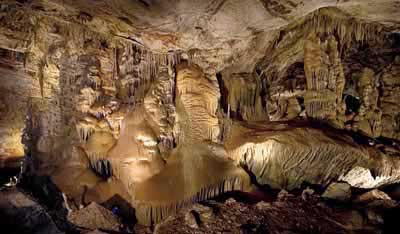 Big Room in Kartchner Caverns. Creative Commons License
Escabrosa Limestone - The Rock Around Kartchner Caverns
The rock containing much of Kartchner Caverns is known as Escabrosa Limestone. It originated as layers of sediment and fossils deposited beneath an ancient shallow sea approximately 330 million years ago. Those deposits eventually hardened into limestone.
Much later, tectonic uplift helped create the Whetstone Mountains. Faulting also dropped a block of the limestone and associated sedimentary rock thousands of feet relative to the mountain peaks above. Kartchner Caverns developed within this faulted block rather than directly beneath the highest part of the present-day mountain range.
How Water Created Kartchner Caverns
Rainwater absorbs carbon dioxide from the atmosphere and especially from soil, becoming slightly acidic. As this water moved through fractures in the buried limestone, it mixed with groundwater and slowly dissolved the calcium-carbonate rock.
This chemical weathering gradually enlarged tiny fractures into openings, passages and rooms. When groundwater levels later dropped, large portions of the cave became air-filled. Some ceilings also collapsed during this process, leaving piles of broken rock known as breakdown on cavern floors.
How Speleothems Form Inside Kartchner Caverns
Creating the underground rooms was only the first stage. Once portions of the cave became filled with air, water continuing to seep downward through the limestone began building the formations visitors see today.
The water dissolves minerals as it travels through the limestone. When a drop reaches the open cave atmosphere, some of its dissolved carbon dioxide escapes. The water can then no longer hold as much dissolved calcium carbonate, so a tiny amount of calcite is deposited.
One deposit is almost invisible, but repeated mineral deposition over hundreds of thousands of years can build massive columns, delicate soda straws, stalactites, stalagmites, flowstone and many other formations. These secondary cave mineral deposits are collectively called speleothems.
Types Of Formations In Kartchner Caverns
Kartchner Caverns contains a wide variety of speleothems formed by differences in water movement, mineral chemistry and cave conditions.
- Stalactites: Form downward from cave ceilings as mineral-bearing water deposits calcite
- Stalagmites: Grow upward from cave floors where drops repeatedly land
- Columns: Form when a stalactite and stalagmite eventually join
- Soda Straws: Delicate hollow tubes that grow downward from ceilings
- Flowstone: Sheet-like mineral deposits formed where water flows across walls or floors
- Draperies: Thin hanging deposits formed as water moves along sloping cave surfaces
- Helictites: Irregular formations that can grow in twisting or branching directions
- Shields: Disk-like formations produced by mineral-rich water moving through cracks
- Rimstone Dams: Mineral barriers that form around pools or flowing cave water
Kubla Khan & Other Notable Formations
Kartchner Caverns contains an exceptional variety of formations, ranging from massive columns to remarkably delicate mineral deposits. One of the best known is Kubla Khan in the Throne Room, identified by Arizona State Parks as the largest column formation in Arizona.
Visitors can also encounter soda straws, flowstone, draperies, shields, helictites and other formations produced by different patterns of water movement and mineral deposition. Their contrasting shapes demonstrate how small variations in cave conditions can produce dramatically different results over long periods of time.
Why Kartchner Caverns Formations Have Different Colors
Pure calcite can appear white or translucent, but many Kartchner Caverns formations contain additional minerals, trace elements or other materials that alter their appearance. These impurities help create the creams, reds, browns and other colors visible throughout the cave.
Kartchner is scientifically notable for its mineral diversity. Researchers have identified minerals belonging to several different chemical classes, helping explain why formations within the same cave can vary considerably in color, texture and appearance.
Why Kartchner Caverns Is Called A Living Cave
Kartchner Caverns is described as a living cave because water still moves from the surface into the cavern and mineral deposition continues today. In other words, its stalactites, stalagmites and other speleothems are not simply ancient remnants—the processes that created them are still active.
The cave's naturally restricted air circulation also helps maintain extremely high humidity. Arizona State Parks reports average relative humidity above 99 percent, conditions that support continuing speleothem growth while also making careful environmental protection especially important.
Ongoing Science At Kartchner Caverns
Kartchner Caverns continues to function as a natural laboratory. Arizona State Parks monitors cave temperature, humidity, carbon dioxide and other environmental conditions to understand both natural changes and the effects of public visitation.
Current and recent research includes studies of dripwater chemistry, stalagmite growth, cave temperature, microorganisms, minerals, fossils and cave-dwelling invertebrates. Dripwater research is especially relevant to cave formation because scientists are studying how rainfall reaches the cave and how water chemistry influences the continued growth of speleothems.
Visiting Kartchner Caverns State Park
This page focuses on the geology and natural processes that created Kartchner Caverns. For current cave tours, reservations, hours, visitor rules, camping, directions and trip-planning information, see the complete Kartchner Caverns State Park visitor guide.
Kartchner Caverns Geology FAQ
How old is the limestone at Kartchner Caverns?
The Escabrosa Limestone containing Kartchner Caverns began as sediment deposited beneath a shallow inland sea approximately 330 million years ago.
How did Kartchner Caverns form?
Slightly acidic rainwater and groundwater entered fractures in limestone and slowly dissolved the rock, enlarging cracks into passages and chambers. After groundwater levels fell, mineral-rich dripwater began depositing calcite and creating speleothems.
What is Escabrosa Limestone?
Escabrosa Limestone is the ancient limestone formation in which much of Kartchner Caverns developed. It originated from marine sediment deposited hundreds of millions of years ago.
What is a speleothem?
A speleothem is a secondary mineral deposit formed inside a cave. Stalactites, stalagmites, columns, soda straws, flowstone and draperies are examples.
How do stalactites form?
Stalactites grow downward from cave ceilings as mineral-bearing water loses carbon dioxide and leaves tiny deposits of calcite behind.
How do stalagmites form?
Stalagmites grow upward from cave floors where mineral-rich drops repeatedly land and deposit calcite.
What is Kubla Khan in Kartchner Caverns?
Kubla Khan is a massive column formation in the Throne Room. Arizona State Parks identifies it as the largest column formation in Arizona.
Why are cave formations different colors?
Pure calcite can be white or translucent, while trace minerals and other materials can alter the color and appearance of cave formations.
Is Kartchner Caverns still growing?
Yes. Kartchner is considered a living cave because water still enters the cavern and mineral deposition continues to form and enlarge speleothems.
How humid is Kartchner Caverns?
Relative humidity inside the cave averages approximately 99 percent, helping maintain the unusual environment in which its formations continue to grow.
Are scientists still studying Kartchner Caverns?
Yes. Current and recent research includes dripwater chemistry, stalagmite growth, cave temperature, microbiology, minerals, fossils and cave ecology.
Can visitors touch Kartchner Caverns formations?
No. Cave formations are extremely fragile, and touching or damaging them is prohibited. Even small disturbances can affect mineral surfaces that developed over very long periods of time.
*Kartchner Caverns State Park is a Registered Trademark of AZ State Parks
Related Tucson Interest
Kartchner Caverns Formation-Creation
Tucson Arizona
Colossal Cave Arizona
Saguaro National Park
San Xavier Del Bac Mission
Tucson Area Map
Tucson Arizona
Tucson Bed & Breakfasts
Tucson Jeep & Hummer Tours
Tucson Pictures
Tucson Weather Info
Southern Arizona Destinations