Bald Eagles In Arizona
Updated by AZ Leisure Staff Writers on
Bald eagles are one of Arizona's most recognizable birds of prey, living and nesting near rivers, reservoirs and lakes from the Sonoran Desert to the Mogollon Rim and White Mountains. Arizona supports a growing resident breeding population as well as additional eagles that move through or winter in the state. These powerful raptors depend heavily on aquatic habitats for fish and other prey and may nest on cliffs, rock pinnacles and large trees near water. Once threatened across much of the United States, the bald eagle has made a remarkable recovery while remaining the focus of active monitoring and conservation in Arizona.
- Bald Eagle Overview
- Identification
- Range And Habitat
- Where To See Bald Eagles
- Nesting And Breeding Season
- Diet And Behavior
- Conservation And Protection
- Best Time To See Bald Eagles
- Wildlife Viewing Tips
- FAQ
Arizona Bald Eagle Overview
The bald eagle, Haliaeetus leucocephalus, is native to North America and has become one of the country's greatest wildlife-conservation success stories. Arizona's population has expanded substantially since intensive monitoring and management began during the 1970s. In 1978, only 11 breeding pairs had been identified in Arizona. By late 2025, Arizona Game & Fish reported 111 documented bald eagle breeding areas across the state.
- Scientific name: Haliaeetus leucocephalus
- Large North American bird of prey
- Resident breeding population in Arizona
- Additional winter and migratory birds occur in the state
- Strongly associated with lakes, reservoirs and rivers
- Fish are an important part of the diet
- Arizona breeding season generally extends from December through August
- Protected by federal wildlife laws
- Actively monitored by Arizona Game & Fish
- Official national bird of the United States since 2024
How To Identify A Bald Eagle
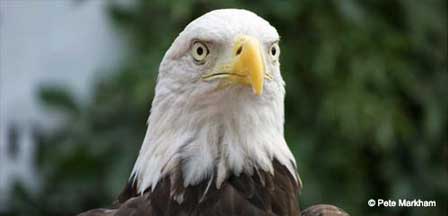
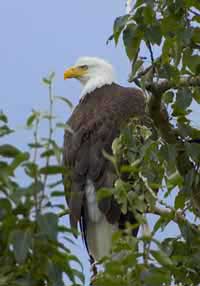
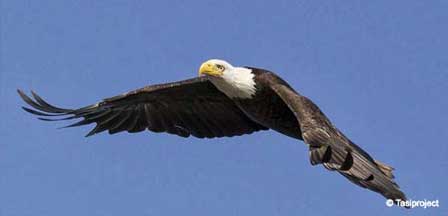
Adult bald eagles are unmistakable when seen well, with dark brown bodies, bright white heads and tails, yellow bills and yellow feet. Females and males have essentially the same plumage, although females are generally larger. Young bald eagles look very different from adults and are primarily brown with varying amounts of white mottling. Their familiar white head and tail develop gradually as the birds mature, typically becoming fully established at about five years of age.
- Adult white head and white tail
- Dark brown body and wings
- Large hooked yellow bill
- Yellow feet and powerful talons
- Broad wings when soaring
- Females generally larger than males
- Juveniles are mostly brown and mottled
- Adult plumage develops gradually over several years
The Bald Eagle Is America's Official National Bird
The bald eagle has appeared on the Great Seal of the United States since 1782 and has represented American independence, strength and freedom for generations. Surprisingly, it was not formally designated by federal law as the national bird until December 23, 2024. Public Law 118-206 amended federal law to officially designate the bald eagle, Haliaeetus leucocephalus, as the national bird of the United States.
Bald Eagle Range And Habitat In Arizona
Arizona bald eagles are closely associated with rivers, reservoirs and lakes that provide fish, other prey and suitable nesting habitat. Breeding territories occur from low-elevation desert waterways to higher-elevation mountain country. Nest sites vary with the landscape and may be located in large cottonwoods and conifers, on cliffs and rock pinnacles, or occasionally on other suitable structures near productive feeding areas.
Arizona's river systems are especially important because breeding eagles depend on dependable food sources and relatively undisturbed nest locations. The Salt and Verde river systems support important breeding habitat, while mountain lakes and rivers along the Mogollon Rim and White Mountains provide significant seasonal habitat.
Best Places To See Bald Eagles In Arizona
Bald eagles can occur anywhere suitable water, prey and roosting habitat come together, but some Arizona regions offer especially good opportunities. Winter typically increases the number and distribution of eagles around lakes and rivers, while resident breeding pairs can be present throughout the year.
- Mogollon Rim: Lakes and rivers provide important winter eagle habitat.
- White Mountains: High-country lakes and waterways attract seasonal bald eagles.
- Verde River: One of Arizona's important bald eagle breeding corridors.
- Salt River: Reservoirs and river habitat support resident and seasonal eagles.
- Lake Pleasant: Supports an established bald eagle breeding area.
- Bartlett Lake And Verde River: Productive aquatic habitat attracts bald eagles.
- Flagstaff Area Lakes: Mountain lakes can attract wintering and migrating eagles.
- Other Arizona Reservoirs: Large lakes with abundant fish may attract both resident and seasonal birds.
Seeing an eagle is never guaranteed. Scan exposed trees, cliffs, shorelines and the sky above open water, particularly during quieter morning hours.
Arizona Bald Eagle Nesting And Breeding Season
Arizona's bald eagle breeding season generally extends from December through August, with lower-elevation desert pairs beginning earlier than birds at higher elevations. Adults may return to established breeding areas, repair or enlarge nests and begin courtship well before eggs are laid.
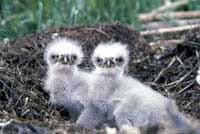
Females commonly lay one to three eggs, and both adults participate in incubation and caring for the young. Incubation lasts approximately five weeks. Young eagles remain dependent on their parents through the nestling and early fledgling stages before gradually becoming independent.
- Breeding activity generally begins in December
- Higher-elevation pairs typically nest later
- One to three eggs may be laid
- Both parents participate in incubation and care
- Young remain dependent after their first flights
- Breeding activity can continue into August
- Seasonal closures may protect sensitive nest areas
Bald Eagle Diet And Behavior
Fish are an important food source for Arizona bald eagles, which helps explain their strong association with lakes, reservoirs and rivers. Eagles may catch live fish near the surface, take injured or dead fish, steal prey from other birds or consume carrion. Their diet can also include waterfowl, small mammals and other available prey.
Bald eagles often perch for long periods in trees, on cliffs or other elevated locations overlooking water. These vantage points allow them to conserve energy while watching for feeding opportunities. They are also powerful soaring birds and may travel considerable distances between feeding, roosting and nesting areas.
Arizona Bald Eagle Conservation And Protection
The recovery of the bald eagle is one of America's major wildlife-conservation successes. The species was removed from the federal Endangered Species Act list in 2007 after populations recovered substantially. Arizona's desert-nesting bald eagles were formally removed from ESA protection in 2011 following additional federal review.
Delisting does not mean bald eagles are unprotected. Bald eagles remain protected under the Bald and Golden Eagle Protection Act and the Migratory Bird Treaty Act. Arizona also continues intensive monitoring and management because recreation, development, fishing line, disturbance and other threats can affect breeding success.
- Arizona Bald Eagle Nestwatch Program
- Annual breeding-area monitoring
- Occupancy and reproductive surveys
- Seasonal nest-area closures where necessary
- Fishing-line recovery efforts
- Public education around breeding areas
- Coordination among state, federal, tribal and conservation organizations
Arizona's Growing Bald Eagle Population
Arizona's bald eagle population has grown dramatically since intensive management began. Only 11 breeding pairs were identified when the species was federally listed in 1978. During the 2024 breeding season, Arizona Game & Fish documented 104 breeding areas, 90 occupied adult pairs, at least 119 eggs, 96 hatchlings and 77 young that reached their first flight. By December 2025, the department reported 111 eagle breeding areas statewide.
The continued increase reflects decades of monitoring, nest protection, habitat management and cooperation among wildlife agencies, tribes and conservation organizations.
Best Time To See Bald Eagles In Arizona
- Winter: One of the best seasons because resident birds are joined by additional eagles using Arizona's lakes and rivers.
- Early Spring: Good opportunities near breeding territories, but visitors must respect closures and keep well away from nests.
- Summer: Resident adults and young may remain around Arizona breeding areas and productive waterways.
- Fall: Eagle distribution begins changing as seasonal birds move into winter habitats.
Winter is generally the easiest season for broad eagle-viewing opportunities, particularly around Mogollon Rim and White Mountains lakes and rivers.
Tips For Watching Bald Eagles
- Use binoculars or a spotting scope.
- Observe eagles from a substantial distance.
- Never approach an occupied nest.
- Obey seasonal wildlife-area closures.
- Keep noise and activity to a minimum near perched birds.
- Do not fly drones near eagles or nests.
- Stay on designated roads and trails.
- Use a telephoto lens instead of approaching for photographs.
- Dispose of fishing line and tackle properly.
- Never feed or attempt to attract bald eagles.
If an eagle repeatedly calls, changes position, circles overhead or leaves a nest because of your presence, you are too close and should move farther away.
Arizona Bald Eagle Video
Arizona Bald Eagle FAQ
Do bald eagles live in Arizona?
Yes. Arizona has a resident breeding population of bald eagles as well as additional birds that move through or winter in the state.
How many bald eagle breeding areas are in Arizona?
Arizona Game & Fish reported 111 documented bald eagle breeding areas statewide in December 2025.
Where are bald eagles most commonly seen in Arizona?
Bald eagles are strongly associated with lakes, reservoirs and rivers. Winter birds are especially common around waterways along the Mogollon Rim and in the White Mountains.
What is the best time to see bald eagles in Arizona?
Winter is generally one of the best seasons because Arizona's resident population is joined by additional seasonal eagles using lakes and river systems.
When do bald eagles nest in Arizona?
Arizona's breeding season generally extends from December through August, with higher-elevation pairs typically nesting later than desert pairs.
What do Arizona bald eagles eat?
Fish are an important food source, but bald eagles may also eat waterfowl, small mammals, carrion and other available prey.
Are bald eagles still endangered?
No. Bald eagles were removed from the federal Endangered Species Act list after recovering, but they remain protected by other federal wildlife laws.
Are bald eagles protected in Arizona?
Yes. Bald eagles remain protected under the Bald and Golden Eagle Protection Act and the Migratory Bird Treaty Act, along with additional state and local management measures.
How can you identify an adult bald eagle?
Adults have a dark brown body, white head and tail, yellow bill and yellow feet. Juveniles are mostly brown and do not develop full adult plumage until several years old.
How many eggs do bald eagles lay?
A female bald eagle commonly lays one to three eggs during a breeding attempt.
Do bald eagles mate for life?
Bald eagle pairs commonly maintain long-term pair bonds and may return to the same breeding territory and nest area in successive years.
Why do Arizona bald eagle nesting areas sometimes close?
Temporary closures reduce human disturbance during sensitive courtship, incubation, nestling and fledgling periods and help improve the chances of successful breeding.
Can I photograph a bald eagle nest?
Yes, when viewing is legally permitted, but photographers should remain far enough away that the birds do not change their behavior. Telephoto lenses, binoculars and spotting scopes are recommended.
When did the bald eagle become the official national bird?
The bald eagle was formally designated the national bird of the United States on December 23, 2024, when Public Law 118-206 was enacted.
More Arizona Wildlife Information
- Arizona Wildlife
- Bird Watching In Arizona
- Golden Eagles In Arizona
- Arizona Elk
- Black Bears In Arizona
- Pronghorn In Arizona
- Bartlett Lake
- Lake Pleasant
- Arizona White Mountains
Arizona Animals