

Arizona Mountain Lions: Habitat, Behavior & Safety
Updated by AZ Leisure Staff Writers on
Mountain lions are among Arizona's largest and most elusive predators, living in deserts, foothills, canyons, forests and rugged mountain ranges across the state. Also known as cougars, pumas and sometimes panthers, these powerful cats are solitary ambush hunters that prey primarily on deer but also take elk, bighorn sheep, pronghorn, javelina and smaller animals.
Mountain lions occur throughout much of the Western Hemisphere, from Canada through the western United States and Mexico into Central and South America. In Arizona they are most often associated with broken, rocky terrain and mountain country that provides cover for stalking prey. Although they are seldom seen because they generally avoid people and are most active at night, mountain lions remain an important part of Arizona's native wildlife community.
Unlike lions, tigers and jaguars, mountain lions cannot roar. They communicate with growls, hisses, screams, chirps and other vocalizations and can also purr.
- Mountain Lion Quick Facts
- Where Mountain Lions Live
- Diet & Hunting
- Characteristics & Behavior
- Arizona Population
- Are Mountain Lions Dangerous?
- What To Do If You See One
- Living In Mountain Lion Country
- When To Report A Sighting
- FAQ
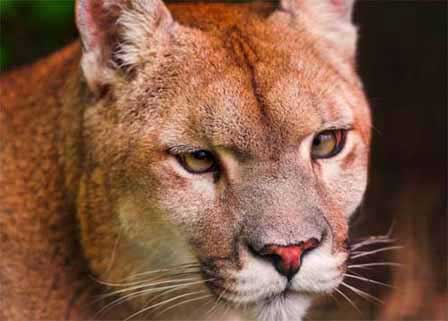 Mountain Lion. Creative Commons
Arizona Mountain Lion Quick Facts
- Scientific name: Puma concolor
- Other names: Cougar, puma and panther
- Arizona population: Approximately 3,000
- Arizona status: Stable to increasing
- Male weight: Commonly 150 pounds or more
- Female weight: Approximately 90 pounds
- Male length: More than 8 feet including the tail
- Primary prey: Deer
- Hunting style: Stalk-and-ambush predator
- Activity: Primarily nocturnal
- Social behavior: Mostly solitary
Where Mountain Lions Live In Arizona
Mountain lions occur throughout Arizona but are most common in rugged mountain country with canyons, rocky slopes, cliffs and dense vegetation. These features provide cover for stalking prey and secluded places for resting and raising kittens.
Suitable habitat extends from Sonoran Desert mountain ranges and foothills to pine forests, rimrock country and high-elevation mountains. Mountain lions can also move through wildland-urban areas near growing communities, especially where natural prey such as deer, javelina and rabbits remain abundant.
Mountain Lion Diet & Hunting
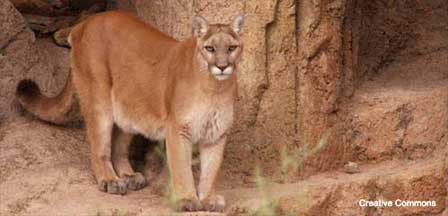
Mountain lions are carnivores and primarily hunt deer. In Arizona they also prey on elk, bighorn sheep, pronghorn, javelina, turkeys, coyotes, bobcats, rodents and other animals when opportunities arise. Mountain lions may occasionally kill livestock, which can create conflicts with ranchers and property owners.
Cougars are stalk-and-ambush predators rather than long-distance pursuit hunters. They use vegetation, rocky terrain and darkness to approach prey before launching a short, powerful attack. Uneaten portions of a kill may be covered with leaves, dirt or other material and revisited later.
Mountain Lion Characteristics & Behavior
Mountain lions are primarily solitary animals. Adults generally avoid one another except during breeding, while females remain with their kittens until the young are ready to live independently. Young mountain lions typically stay with their mother for roughly 11 to 18 months.
Home-range size varies greatly depending on prey, terrain, sex, habitat quality and competition. Males generally occupy larger areas than females and may overlap the ranges of several females.
Mountain lions are secretive and are primarily active at night, although they may also move during daylight hours. Their long tails aid balance while climbing, running and moving across rugged terrain.
Adult mountain lions have long, muscular bodies and tails that can make up more than one-third of their total length. Arizona Game and Fish lists adult males at more than eight feet long including the tail and commonly 150 pounds or more, while females average closer to 90 pounds and may reach about seven feet in total length.
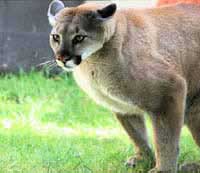
Adults are generally tan to light cinnamon with pale underparts and darker markings on the backs of the ears and tip of the tail. Kittens are born with spotted coats, which gradually fade as they mature.
How Many Mountain Lions Live In Arizona?
Arizona Game and Fish currently estimates that approximately 3,000 mountain lions live in the state. The department describes Arizona's population as stable to increasing and reports that mountain lions are widely distributed across suitable habitat.
The state's mountain lion population recovered from much lower levels during the twentieth century and is now managed as a big-game species using research, population monitoring and regulated hunting.
Are Mountain Lions Dangerous?
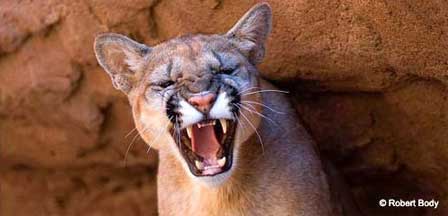
Mountain lion attacks on people are rare, but these are large predators capable of seriously injuring or killing a person. Most mountain lion encounters are nonaggressive, and the animals typically try to avoid humans.
Encounters can become more likely where housing and recreation overlap mountain lion habitat, particularly when deer, javelina, rabbits, pets or livestock attract lions into developed areas. Drought, wildfire and habitat fragmentation can also influence where mountain lions travel.
Children and unattended pets require particular attention in mountain lion country because of their smaller size.
What To Do If You Encounter A Mountain Lion
- Do not approach the mountain lion and give it a clear route to escape.
- Stay calm and speak loudly and firmly.
- Do not run. Running can trigger a mountain lion's instinct to chase.
- Stand and face the mountain lion while maintaining eye contact.
- Make yourself appear larger by raising your arms or opening your jacket.
- Slowly back away toward a building, vehicle or populated area.
- Keep children close and prevent them from running.
- If necessary, throw stones or branches without crouching or turning your back.
- If a mountain lion attacks, fight back aggressively.
- Try to remain standing and protect your head and neck during an attack.
Living & Recreating In Mountain Lion Country
- Hike or walk in groups when possible, particularly during daylight hours.
- Closely supervise children outdoors in mountain lion habitat.
- Keep dogs on a leash while hiking.
- Keep pets and small livestock in secure enclosures, especially at night.
- Do not leave pet food outdoors.
- Do not intentionally feed deer, javelina or other wildlife that may attract mountain lions.
- Trim dense vegetation near homes and children's play areas.
- Use outdoor lighting around frequently used areas at night.
- Never intentionally approach or feed a mountain lion.
When To Report A Mountain Lion
Seeing a mountain lion in remote habitat does not automatically mean the animal is dangerous. However, Arizona Game and Fish asks residents to report mountain lion encounters and attacks, sightings in urban areas, property damage caused by mountain lions and possession of a live mountain lion.
In an emergency or attack, call 911. Arizona Game and Fish currently lists its 24-hour dispatch number as 623-236-7201 for mountain lion encounters, urban sightings and related wildlife conflicts.
Arizona Mountain Lions FAQ
Are There Mountain Lions In Arizona?
Yes. Mountain lions occur throughout Arizona and are especially common in rugged mountain terrain, canyons and rocky areas with suitable prey.
How Many Mountain Lions Live In Arizona?
Arizona Game and Fish currently estimates that approximately 3,000 mountain lions live in the state.
What Do Arizona Mountain Lions Eat?
Deer are their primary prey, but mountain lions also eat elk, bighorn sheep, pronghorn, javelina, turkeys, coyotes, rodents and other animals.
Where Are Mountain Lions Most Common In Arizona?
They are most common in mountainous areas with rugged terrain, canyons, rocky slopes and vegetation that provides cover for stalking prey.
Are Mountain Lions Dangerous To People?
Mountain lion attacks are rare, but they are powerful predators capable of seriously injuring or killing a person. Most encounters are nonaggressive.
What Should I Do If I See A Mountain Lion?
Do not run or approach it. Face the mountain lion, make yourself appear larger, speak firmly, maintain eye contact and slowly back away while giving the animal room to leave.
Should You Fight Back If A Mountain Lion Attacks?
Yes. Arizona Game and Fish recommends fighting back aggressively if attacked and trying to remain standing while protecting your head and neck.
Are Mountain Lions Active During The Day?
They can be active at any time, but mountain lions are primarily nocturnal and are often most active during periods of low light.
Can Mountain Lions Roar?
No. Mountain lions cannot roar like lions or tigers. They communicate through growls, hisses, screams, chirps and other vocalizations and can also purr.
Do Mountain Lions Live Near Arizona Cities?
They generally avoid heavily populated areas, but mountain lions can move through wildland-urban neighborhoods where communities border suitable habitat.
Arizona Animals