
Arizona Ringtail: State Mammal, Habitat & Facts
Reviewed and updated by AZ Leisure Staff Writers on .
The ringtail (Bassariscus astutus) is Arizona's official state mammal and one of the state's most elusive native animals. Often called a ringtail cat because of its cat-like appearance, it is actually a member of the raccoon family and is closely related to raccoons and coatis.
Ringtails are small, mostly nocturnal mammals recognized by their large eyes, pointed faces and long bushy tails marked with bold black-and-white rings. They are exceptional climbers and are found throughout much of Arizona, particularly in rocky canyons, cliffs, boulder fields, caves, mine tunnels and other rugged habitats that provide secure daytime den sites.
Because ringtails usually rest during daylight and become active after dark, many Arizona residents never see one in the wild. Their secretive habits, remarkable climbing ability and distinctive striped tails make a ringtail sighting especially memorable.
- About Arizona Ringtails
- Habitat & Range
- Arizona State Mammal
- Behavior & Climbing
- What Ringtails Eat
- Reproduction & Young
- Are Ringtails Dangerous?
- What To Do If You See One
- Quick Ringtail Facts
- Ringtail Video
- FAQ
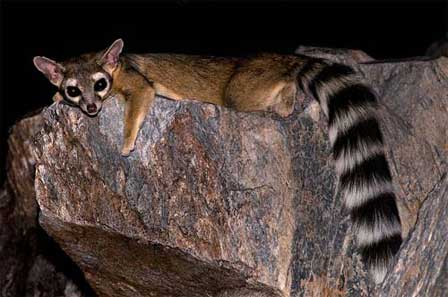 Ringtail. © Robert Body
About Arizona Ringtails
The ringtail is a small member of the raccoon family, Procyonidae. Although it is often called a ringtail cat or miner's cat, it is not a feline. Its fox-like face, large rounded ears, prominent eyes and long striped tail give it a distinctive appearance unlike any other Arizona mammal.
Adult ringtails typically weigh about 2 to 2.5 pounds. The body averages roughly 14 to 16 inches long, while the bushy tail can reach approximately 15 inches in length. Their relatively small size and flexible bodies help them move through narrow rock crevices and rugged canyon terrain.
Ringtail Habitat & Range In Arizona
Ringtails occur across much of Arizona and are especially associated with rugged terrain. Arizona Game and Fish describes their distribution as essentially statewide, although they are generally absent from most broad flatlands and the highest elevations.
Preferred habitat often includes rocky canyons, cliffs, boulder fields, caves, mine tunnels, riparian corridors, woodland and desert terrain where suitable den sites and food are available. During the day, ringtails commonly shelter in rock crevices, caves, hollow trees and other protected spaces.
Beyond Arizona, ringtails occur across much of the southwestern United States and south into Mexico.
Why The Ringtail Is Arizona's State Mammal
Arizona officially designated the ringtail (Bassariscus astutus) as the state mammal in 1986. The species is well suited to Arizona's rugged landscapes and occurs across much of the state in rocky desert, canyon and woodland habitats.
The ringtail's combination of elusive nocturnal behavior, remarkable climbing ability and distinctive black-and-white tail has made it one of Arizona's most recognizable native mammals even though relatively few people encounter one in the wild.
Ringtail Reproduction & Young
Ringtails are generally solitary except during the breeding season, which occurs from late winter into spring. Mating commonly takes place from approximately February through May.
Gestation lasts about 51 to 54 days. Young are typically born in spring in protected dens such as rock crevices, boulder piles or hollow trees. Litters commonly contain two to four young. Newborn ringtails are initially unable to see or hear and depend completely on their mother.
Young begin eating solid food after several weeks and are generally weaned at around 10 weeks. By approximately four months of age they have developed their adult coloration.
Are Ringtail Cats Dangerous?
Ringtails are secretive wild animals and normally avoid people. A healthy wild ringtail generally prefers escape and concealment rather than confrontation.
Like any wild mammal, however, a ringtail may bite or scratch if cornered, handled or threatened. Never attempt to catch, touch or hand-feed one. Keep pets away and give the animal an unobstructed route to leave.
If a ringtail repeatedly enters an attic, garage or other structure, remove accessible food sources and seek appropriate wildlife-exclusion advice rather than attempting to handle the animal yourself.
Ringtail Behavior & Climbing Ability
Ringtails are mostly nocturnal and solitary. They typically spend daylight hours hidden in a den and emerge after dark to forage and move through their territory.
One of the ringtail's most remarkable adaptations is its ability to rotate its hind feet approximately 180 degrees. This allows the animal to maintain traction while descending steep rocks and tree trunks headfirst. Ringtails can also move through narrow rock crevices and climb nearly vertical surfaces, making rugged canyon country ideal habitat.
What Do Arizona Ringtails Eat?
Ringtails are opportunistic omnivores. Their diet includes insects, rodents and other small mammals, reptiles, birds, fruit and carrion. What they eat varies with season and local food availability.
Their ability to climb and squeeze through confined spaces allows ringtails to forage in rocky areas, trees and around structures. Ringtails living near people may sometimes investigate buildings, pet food or other potential food sources, so wildlife should never be intentionally fed.
Ringtail Predators & Defense
Predators of ringtails can include coyotes, bobcats, foxes and large owls. Their small size makes secure daytime dens and exceptional climbing ability important defenses against larger predators.
When threatened, ringtails can vocalize with barks, screams and other calls and may use scent as part of their defensive and territorial behavior. Remaining hidden and escaping through steep or confined terrain are among their most effective protections.
What To Do If You See A Ringtail In Arizona
- Enjoy the sighting from a respectful distance.
- Do not approach, touch, trap or attempt to pick up the animal.
- Never intentionally feed a ringtail or leave food outside to attract one.
- Keep dogs and other pets away from the animal.
- Give the ringtail a clear escape route if it is near a home or campsite.
- Secure pet food, garbage and other potential food sources at night.
- If one enters a building, avoid cornering it and use appropriate wildlife-exclusion practices.
- Contact a wildlife professional or Arizona Game and Fish when an animal appears injured, trapped or unusually aggressive.
Arizona Ringtail Video
Arizona Ringtail FAQ
What Is A Ringtail?
A ringtail is a small nocturnal mammal in the raccoon family. Its scientific name is Bassariscus astutus, and it is recognizable by its large eyes and long black-and-white ringed tail.
Is A Ringtail Really A Cat?
No. Despite the common nickname ringtail cat, the ringtail is not a feline. It belongs to the raccoon family and is related to raccoons and coatis.
Is The Ringtail Arizona's State Mammal?
Yes. Arizona officially designated the ringtail as its state mammal in 1986.
Where Do Ringtails Live In Arizona?
Ringtails occur across much of Arizona and favor rugged habitats such as rocky canyons, cliffs, boulder fields, caves, mine tunnels and some woodland and riparian areas.
Are Ringtails Nocturnal?
Yes. Ringtails are mostly nocturnal, spending much of the day in protected dens and becoming active after dark.
What Do Arizona Ringtails Eat?
Ringtails are omnivores that eat insects, rodents and other small mammals, reptiles, birds, fruit and carrion.
How Big Is A Ringtail?
An adult ringtail typically weighs about 2 to 2.5 pounds. Its body averages roughly 14 to 16 inches long, and the tail can reach about 15 inches.
Can Ringtails Climb Trees And Cliffs?
Yes. Ringtails are exceptional climbers. They can rotate their hind feet approximately 180 degrees, helping them descend steep rocks and tree trunks headfirst.
Are Ringtails Dangerous To People?
Ringtails are generally shy and avoid people. As with any wild animal, they may bite or scratch if cornered or handled, so they should always be observed from a safe distance.
Can You Keep A Ringtail As A Pet?
Ringtails are wild animals and should be left in the wild. Do not capture or attempt to domesticate a wild ringtail.
When Do Ringtails Have Babies?
Ringtails breed from late winter into spring. After a gestation of about 51 to 54 days, young are generally born during spring.
Why Are Ringtails Sometimes Called Miner's Cats?
The nickname miner's cat comes from the historical association of ringtails with mining areas and structures, where their ability to hunt rodents made them useful neighbors around camps and buildings.
Arizona Animals