Arizona White-Throated Packrat
Brooke Bessesen
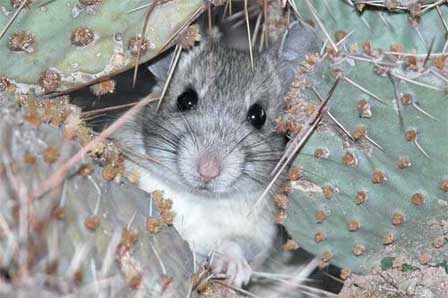 White-Throated Pack Rat - © Greg Smith
The little fellow meant no harm. As packrats go, he was surely an upstanding member of his community. Like most of us, he was working diligently to bring home the bacon (er... seeds) and trying to avoid doing business with any snakes. He didn't realize that the bright, fresh strawberries growing on your porch weren't put there for his dining pleasure or that rustling around in those delightful paper-stuffed boxes in the garage was keeping you awake and jumpy all night.
If only these issues could have been resolved between human and animal neighbor in a civilized fashion. Little CC&Rs could have been posted so that everyone might live together in peace. But of course there was no formal hearing with the Association and Mr. Packrat was roughly evicted without so much as the chance to defend his rights.
Packrat is a slang term used for a wood rat, a fluffy, dark liquid-eyed rodent with an affinity for collecting trinkets and storing them in its nest area. Gathering items from its environment is the equivalent of going garage-saling, and packrats are known to like sparkling earrings as much as the next person. Other treasured items often include twigs, scraps of garbage, gum wrappers, dust-bunnies, and a real favorite: dog poop.
Active at night, packrats forage for food and indulge their hobby of stockpiling. They are rarely seen during the day, so unless they're infesting an area, they usually remain harmless. Nevertheless, they are sometimes considered "pests". Pests come in two distinct categories: Animals that are really causing a problem and animals for which someone simply has a psychological distaste. Typically, packrats fall into the latter category.
For the most part, people enjoy being surrounded by nature and look to create yards that will attract creatures like birds and butterflies. So a packrat or two moves in. Maybe some rabbits, crickets, a snake or a curious ground squirrel. As long as they are not causing any real challenges, it might be worth letting them stay. They truly help provide the beauty and balance that are found on a desert vista or a mountain trail - those places to which we escape for the purpose of soothing our minds. What a treat to have such wonder just outside the arcadia door.
If Mr. Packrat Becomes A Pest
As for inside, it seems only fair to ask that Mr. Packrat not live in the walls and steal pillow stuffing. Meeting a Mrs. and raising a family behind the office bookcase is not to be encouraged. But maybe, just maybe, sharing some summer strawberries on the back porch wouldn't be such an inconvenience. After all, it could be argued that it's the neighborly thing to do.
Humanely dealing with animals that are doing damage requires investigating all the options. People often feel they have no alternative, and rush to the store to pick up cruel but well-marketed pest control items. Sticky paper is one product that I particularly dread, since its victims die a slow, agonizing death from dehydration. But poisoning is perhaps the worst, since it is not only an excruciating way to die, but also an excruciating thing to watch or medically treat.
At the crux of poisoning is damage to the biological food chain. The key here is that everything is linked. It is rare that wildlife rehab centers get a small packrat into the clinic for treatment of poisoning. More often, they see the dead hawk that ate him or the deceased coyote who ate the dead hawk. Poison, like most chemicals, keeps its structure for quite awhile and travels like a computer virus through the ecological community.
For packrats, or similar animals,, one of the most effective and often over-looked solutions is buying or borrowing a humane live-animal trap (they look somewhat like a rabbit enclosure with a spring-loaded door, and come in several sizes.) Humane live traps and can be purchased or rented at many livestock supply stores, found under the Feed Dealers heading in your Yellow Page directory.
Once captured, simply relocate the critter to a less troublesome location. I will add that it's important to understand something about the species in order to transfer it to an appropriate area, offering it a better chance of survival after the move.
Packrat Facts
A Packrat is the nickname for a "Woodrat". There are 22 species of which eight reside in the Southwest including Arizona. The Bushy-tailed Woodrat was the "original" packrat because of its pronounced trading habits.
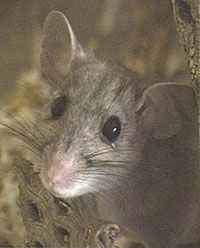
Description. gray or tan on the back with a light underside, often peppered. Large eyes and ears, and long whiskers.
Size. Head and body: 6-9" in length, Tail: 5 to 9".
Weight. 6 to 15oz.
Diet. Herbivorous: dines on fruit, seeds and other foliage.
Range. From the southeastern Canada, down through Northwest U.S. and into parts of California, Nevada, Arizona and New Mexico.
Habitat. Rocky areas and coniferous forests.
Nests. Nest sites usually begins with a large pile of twigs in a crevice or under a log this particular species may build its nest in a tree if living in a forested area). Nests are also called "middens", the archaeological term for 'garbage pile'. Packrats collect items from their environment (leaves, bones, stool from other animals) and add them to their nests (this species particularly loves shiny articles - coins, keys, spoons). By urinating on their nests, packrats seal the items together with crystallized amber cement.
Socialization. Nocturnal and solitary, although may share a large nest site with other packrats over several generations. Packrats sometimes make tapping sounds with their back feet when disturbed.
Breeding/Reproduction. Usually 1 to 2 litters born in May-September, with 2-6 young in each.
Nifty Fact. Ancient packrat middens have been discovered that date back 50,000 years into the Pleistocene Era (also known as the Ice Age). Because the urine resin perfectly preserves collected material, scientists can study the early flora and fauna from that landscape.
Scientific Name. Neotoma Cinerea.
About Brooke Bessesen. Brooke is a Naturalist, Author, Illustrator, Educator, and Television Producer. She has written "Look Who Lives In The Desert" and is currently writing "Look Who Lives In The Ocean" and "Zachary Z. Packrat".
Arizona Animals