White-Tailed Deer In Arizona
Updated by AZ Leisure Staff Writers on
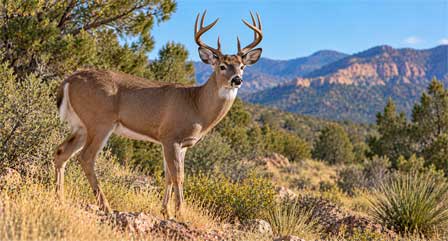
White-tailed deer in Arizona are best known as Coues white-tailed deer, a smaller subspecies especially associated with the mountain ranges of southeastern and central Arizona. These wary deer inhabit oak woodlands, brushy foothills, mountain canyons, riparian areas and some pine forests, typically where vegetation provides both food and cover. Coues deer are recognizable by their broad white-underlined tail, white facial markings and compact build, and wildlife watchers often have the best chance of seeing them during quiet periods around dawn and dusk.
 Arizona White-Tailed Deer
- About Coues Deer
- Habitat & Range
- Where To See Them
- Identification
- Behavior & Diet
- Wildlife Viewing Tips
- White-Tailed Deer vs Mule Deer
- FAQ
About Coues White-Tailed Deer In Arizona
The Coues white-tailed deer (Odocoileus virginianus couesi) is the white-tailed deer subspecies most closely associated with Arizona. Smaller than the mule deer commonly seen across the state, Coues deer are particularly well adapted to rugged mountain terrain and dense woodland cover. Arizona Game & Fish reports that they are most common in southeastern Arizona, with their range extending north to the Mogollon Rim and into the White Mountains.
White-Tailed Deer Habitat & Range In Arizona
Coues white-tailed deer are strongly associated with central and southeastern Arizona's mountain country. Important habitats include evergreen oak woodland, oak-juniper and pinyon woodland, brushy slopes, riparian corridors, semidesert grassland adjoining wooded cover and some ponderosa pine forest. Arizona Game & Fish places their primary Arizona range at roughly 4,000 to 10,000 feet in elevation, although local habitat conditions are more important than elevation alone.
Dense vegetation and broken terrain provide escape cover, while seasonal rainfall influences forage and habitat quality. The strongest populations occur in southeastern mountain ranges, with white-tailed deer also extending north toward the Mogollon Rim and White Mountains.
Best Places To See White-Tailed Deer In Arizona
Wild white-tailed deer can be difficult to spot because they often remain close to woodland and brush cover. Southeastern Arizona's forested mountain ranges provide some of the state's most characteristic Coues deer habitat.
- Coronado National Forest: Extensive oak woodland, mountain canyons and forest habitat across southeastern Arizona.
- Huachuca Mountains: Wooded slopes, canyons and brushy mountain terrain near Sierra Vista.
- Santa Rita Mountains: Oak woodland, foothills and canyon habitat south of Tucson.
- Madera Canyon: Forested canyon habitat in the Santa Rita Mountains with good wildlife-viewing opportunities.
- Chiricahua Mountains: Remote wooded canyons and rugged mountain terrain in southeastern Arizona.
- Santa Catalina Mountains: Mountain woodland and canyon habitat north of Tucson.
- Mogollon Rim Country: The northern portion of the Coues deer range includes suitable woodland and forest habitat along parts of central Arizona's Mogollon Rim.
How To Identify A White-Tailed Deer In Arizona
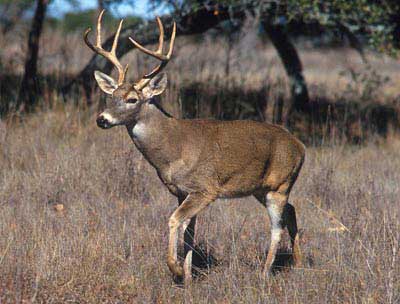
Several features help distinguish a Coues white-tailed deer from Arizona's mule deer. The most obvious is the tail: a white-tailed deer has a broad, fluffy tail that is dark above and bright white underneath and is often raised or “flagged” when the deer is alarmed. Adults also have noticeable white markings around the eyes and muzzle.
- Tail: Broad and fluffy with a conspicuous white underside.
- Face: White markings around the eyes and muzzle.
- Antlers: Bucks have tines that rise from a main antler beam rather than repeatedly forking.
- Build: Coues deer are relatively small and compact compared with Arizona mule deer.
- Movement: White-tailed deer typically run rather than using the stiff-legged bounding gait associated with mule deer.
White-Tailed Deer Behavior & Diet
Coues deer are wary animals that use vegetation and rugged terrain to remain concealed. They often become most active during the cooler periods around dawn and dusk, moving between bedding cover and feeding areas. When alarmed, a white-tailed deer may raise its broad white tail as it runs into cover.
These deer browse on a changing variety of leaves, twigs, grasses, forbs, shrubs and other available vegetation. Their exact diet varies with elevation, rainfall and season, and the distribution and quality of food can change substantially between Arizona's dry periods and summer rainy season.
Tips For Seeing White-Tailed Deer In Arizona
- Look early and late: Dawn and dusk are often productive periods for observing deer activity.
- Scan habitat edges: Watch openings beside oak woodland, brush, canyon bottoms and forest edges.
- Move quietly: Coues deer are alert and may disappear into cover before visitors notice them.
- Use binoculars: Viewing from a distance improves the chance of watching natural behavior without disturbing the animal.
- Watch hillsides carefully: Their gray-brown coloration can blend remarkably well with oak woodland and rocky mountain terrain.
- Stay on established routes: Avoid pursuing deer through bedding areas or dense vegetation simply for a closer photograph.
- Never feed wildlife: Observe deer without offering food or attempting to attract them closer.
White-Tailed Deer vs Mule Deer In Arizona
Arizona is home to both white-tailed deer and mule deer. Mule deer are much more widespread across the state and tend to be larger, with oversized ears, a narrow black-tipped tail and antlers that typically fork. Coues white-tailed deer are smaller and more strongly associated with mountain woodland and brushy cover in central and southeastern Arizona.
- White-tailed deer tail: Broad and fluffy with a bright white underside that may be raised when alarmed.
- Mule deer tail: Narrower, generally white with a conspicuous black tip.
- White-tailed deer antlers: Individual tines grow upward from a main beam.
- Mule deer antlers: Main antler branches typically fork into additional branches.
- White-tailed deer movement: Usually run with a more conventional stride.
- Mule deer movement: Often escape with a distinctive stiff-legged bounding gait.
Arizona White-Tailed Deer FAQ
What kind of white-tailed deer live in Arizona?
Arizona is especially known for the Coues white-tailed deer, a relatively small subspecies of white-tailed deer found primarily in central and southeastern Arizona's mountain country.
Where do white-tailed deer live in Arizona?
They are most common in southeastern Arizona mountain ranges and occur in oak woodland, brushy foothills, riparian areas, mountain canyons and some pine forests. Their range extends north toward the Mogollon Rim and White Mountains.
What elevation do white-tailed deer live at in Arizona?
Arizona Game & Fish reports that Coues white-tailed deer are commonly found from about 4,000 to 10,000 feet in central and southeastern Arizona.
How can you identify a Coues white-tailed deer?
Look for a relatively small deer with white markings around the eyes and muzzle and a broad tail that is dark above and bright white underneath. Bucks have antler tines growing from a main beam.
Are white-tailed deer and mule deer the same?
No. They are different deer species. Mule deer are larger and more widespread in Arizona, with large ears, a narrow black-tipped tail and typically forked antlers.
Where is the best place to see white-tailed deer in Arizona?
Southeastern Arizona mountain ranges provide some of the state's best habitat, including areas within the Coronado National Forest, Huachuca Mountains, Santa Rita Mountains and Chiricahua Mountains.
When are white-tailed deer most active?
They are often easiest to observe during cooler periods around dawn and dusk, although activity varies with weather, season and human disturbance.
What do Arizona white-tailed deer eat?
They browse on leaves, twigs, shrubs, grasses, forbs and other seasonal vegetation. Their diet changes with habitat, rainfall and time of year.
Do white-tailed deer live in northern Arizona?
The core Arizona range is farther south, but Coues white-tailed deer extend north through central Arizona to portions of the Mogollon Rim and White Mountains.
Should visitors feed wild deer?
No. Wild deer should be observed from a respectful distance and should not be fed or approached for photographs.
Arizona Animals
Wildlife Creatures
Wildlife in Arizona
Javelina
Bobcats (Wildcats)
Black Bear
Venomous Animals
Pronghorn Antelope
Coyotes
Ringtail Cat
Arizona Badger
Mountain Lions
Arizona Elk
Bald Eagle
Desert Bighorn Sheep
White Tail Deer
Golden Eagle