
Lowell Observatory In Flagstaff Arizona
Updated by AZ Leisure Staff Writers on
Lowell Observatory in Flagstaff, Arizona is one of America's most historic astronomical research institutions and the site where Clyde Tombaugh discovered Pluto in 1930. Founded by astronomer Percival Lowell in 1894 on Mars Hill, the observatory has contributed to major advances in planetary science, cosmology and our understanding of the expanding universe.
Today Lowell combines active astronomical research with one of Arizona's most distinctive visitor experiences. Guests can explore the historic Clark Telescope and Pluto Discovery Dome, visit the modern Astronomy Discovery Center, view the Sun and night sky through public telescopes and learn about more than 130 years of astronomical discovery beneath Flagstaff's renowned dark skies.
- Lowell Observatory Quick Facts
- History & Pluto Discovery
- What To See
- Astronomy Discovery Center
- Stargazing & Telescopes
- Astronomy Research
- Planning Your Visit
- Visitor Tips
- Nearby Attractions
- FAQ
Lowell Observatory Quick Facts
- Location: Mars Hill in Flagstaff, Arizona
- Founded: 1894 by Percival Lowell
- Famous discovery: Pluto, discovered by Clyde Tombaugh in 1930
- Historic telescope: 24-inch Clark Refractor
- Pluto telescope: 13-inch Lawrence Lowell Astrograph
- Modern visitor center: Astronomy Discovery Center
- Public observing: Historic and modern telescopes available during scheduled programs and suitable weather
- Major research telescope: 4.3-meter Lowell Discovery Telescope
- Elevation: Approximately 7,250 feet on Mars Hill
- Address: 1400 W. Mars Hill Road, Flagstaff, Arizona
Lowell Observatory History & The Discovery Of Pluto
Percival Lowell founded Lowell Observatory in Flagstaff in 1894, initially focusing much of his research on Mars and the possibility of life beyond Earth. The observatory soon grew into a major astronomical research institution whose scientists made important contributions to planetary science and cosmology.
One of Lowell's most significant early achievements came from astronomer Vesto M. Slipher, whose measurements of galaxy redshifts provided critical early evidence that the universe is expanding. In 1930, 24-year-old Clyde Tombaugh made the observatory's most famous discovery when he identified Pluto while comparing photographic plates taken with the 13-inch Lawrence Lowell Astrograph.
Lowell Observatory has continued to contribute to astronomy for more than 130 years, including research involving the rings of Uranus, Pluto's atmosphere, asteroids, exoplanets, galaxies and dark matter.
What To See At Lowell Observatory
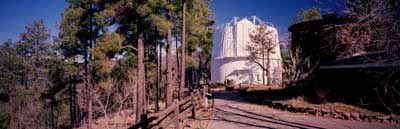
- Historic Clark Telescope: The 24-inch refractor commissioned by Percival Lowell and completed in 1896 remains one of the observatory's signature historic instruments.
- Pluto Discovery Dome: See the 13-inch Lawrence Lowell Astrograph used by Clyde Tombaugh to photograph the plates that led to Pluto's discovery.
- Astronomy Discovery Center: Explore interactive astronomy exhibits, galleries, family activities and immersive presentations.
- Giovale Open Deck Observatory: View the sky through six advanced public telescopes.
- Dark Sky Planetarium: Experience live outdoor night-sky presentations beneath Flagstaff's protected dark skies.
- Rotunda Museum: Explore Lowell's astronomical history and artifacts inside the historic Slipher Building.
Astronomy Discovery Center
Opened in November 2024, the Astronomy Discovery Center is now the primary visitor hub at Lowell Observatory. The facility dramatically expanded the public experience on Mars Hill with hands-on exhibits, interactive galleries, astronomy presentations and spaces designed for both children and adults.
Highlights include the Stardust Lab Astronomy Gallery, Orbits Curiosity Zone for younger visitors, Origins Gallery, Lowell Universe Theater and the rooftop Dark Sky Planetarium. General admission also provides access to many of Lowell's historic exhibits and public observing experiences.
Stargazing & Telescope Viewing
Nighttime telescope viewing is one of the highlights of a Lowell Observatory visit. Weather permitting, visitors can observe planets, stars, nebulae, galaxies and other celestial objects through a combination of historic and modern telescopes.
The Giovale Open Deck Observatory features six advanced public telescopes, while the historic Clark Telescope continues to provide visitors with views through an instrument that played an important role in astronomical history. Telescope viewing typically begins around sunset, with exact start times changing throughout the year.
The rooftop Dark Sky Planetarium offers another distinctive nighttime experience, using Flagstaff's actual night sky for live guided astronomy presentations. Programs and telescope availability depend on weather and the day's schedule.
Astronomy Research At Lowell Observatory
Lowell Observatory remains an active astronomical research institution rather than simply a historic attraction. Its scientists study objects ranging from asteroids, comets and planets in our solar system to exoplanets, stars, galaxies and dark matter.
Lowell's flagship research instrument is the 4.3-meter Lowell Discovery Telescope southeast of Flagstaff near Happy Jack. The telescope supports multiple scientific instruments and research partnerships with universities and other institutions while allowing astronomers to study a wide variety of astronomical targets.
Research also continues through additional Lowell facilities and collaborations, maintaining the scientific mission that began with Percival Lowell in 1894.
Historic Clark Telescope
The 24-inch Clark Refractor is one of Lowell Observatory's most important historic instruments. Commissioned by Percival Lowell in 1895 and completed by Alvan Clark & Sons in 1896, it was used for Lowell's studies of Mars and later contributed to other major astronomical work.
The Clark also played a role in preparations for the Apollo Moon missions. Scientists and artists used observations through the telescope to help create detailed lunar maps before astronauts traveled to the Moon. Today the restored telescope is dedicated primarily to education and public observing.
Where Pluto Was Discovered
Clyde Tombaugh discovered Pluto at Lowell Observatory in February 1930 after months of photographing and comparing sections of the night sky. He used the 13-inch Lawrence Lowell Astrograph to create large photographic plates and searched them for objects that moved against the background stars.
Visitors can see the historic telescope inside the Pluto Discovery Dome and learn how Tombaugh's painstaking search for Percival Lowell's predicted "Planet X" resulted in one of the most famous discoveries in twentieth-century astronomy.
Planning A Visit To Lowell Observatory
Lowell Observatory is located at 1400 W. Mars Hill Road in Flagstaff, approximately one mile west of historic downtown. The Mars Hill campus sits at about 7,250 feet elevation and is accessible by vehicle from central Flagstaff.
Lowell Observatory offers daytime exhibits and programs as well as evening telescope viewing. Operating days, hours, admission prices and individual program schedules can change, so visitors should check the official Lowell Observatory website before arriving rather than relying on fixed times published on older travel guides.
General admission reservations are typically not required, although certain premium experiences do require advance reservations. Visitors commonly spend about two hours at the observatory, but astronomy enthusiasts can easily spend considerably longer exploring the historic campus, exhibits and nighttime programs.
Lowell Observatory Visitor Tips
- Plan to stay after sunset if nighttime telescope viewing is an important part of your visit.
- Check the day's program schedule because telescope viewing, tours and presentations vary.
- Dress warmly for evening programs. Mars Hill is above 7,000 feet and temperatures can drop rapidly after sunset.
- Allow at least two hours, and considerably more if you want to explore both daytime exhibits and evening stargazing.
- Clouds, wind and precipitation can limit or cancel telescope viewing even when the observatory itself remains open.
- Families with children should allow extra time for the interactive exhibits inside the Astronomy Discovery Center.
- Premium experiences may require advance reservations even when general admission does not.
- Visit the Pluto Discovery Dome and Clark Telescope even if weather prevents nighttime observing; both are important historical attractions in their own right.
Attractions Near Lowell Observatory
- Historic Downtown Flagstaff — Restaurants, shops, historic buildings and Route 66 attractions about a mile from Mars Hill.
- The Arboretum At Flagstaff — High-elevation gardens, native plants and nature programs southwest of downtown.
- Flagstaff Museums — Explore additional science, history and cultural attractions.
- Sunset Crater Volcano — Volcanic landscapes and trails northeast of Flagstaff.
- Walnut Canyon — Canyon scenery, trails and archaeological sites east of Flagstaff.
- Arizona Snowbowl — Mountain recreation on the San Francisco Peaks northwest of Flagstaff.
Lowell Observatory Visitor Information
- Official Lowell Observatory Visitor Guide — Current hours, admission, programs and visitor information.
- Astronomy Discovery Center — Current exhibits and visitor experiences.
- Flagstaff Arizona Guide — Lodging, attractions and trip-planning information.
- Flagstaff Weather — Seasonal temperatures and climate information.
- Flagstaff Area Map — Regional orientation and directions.
Lowell Observatory FAQ
Where Is Lowell Observatory?
Lowell Observatory is located at 1400 W. Mars Hill Road in Flagstaff, Arizona, approximately one mile west of historic downtown Flagstaff.
What Is Lowell Observatory Famous For?
Lowell Observatory is best known as the place where Clyde Tombaugh discovered Pluto in 1930. The observatory has also made important contributions to planetary science, cosmology and research into the expanding universe.
Who Founded Lowell Observatory?
Astronomer Percival Lowell founded Lowell Observatory in Flagstaff in 1894, initially focusing much of his research on Mars and the search for another planet beyond Neptune.
Can You See The Telescope That Discovered Pluto?
Yes. Visitors can see the 13-inch Lawrence Lowell Astrograph inside the Pluto Discovery Dome. Clyde Tombaugh used this telescope to photograph the plates that led to Pluto's discovery.
Can You Look Through Telescopes At Lowell Observatory?
Yes. Weather permitting, Lowell offers public observing through historic and modern telescopes, including the Clark Telescope and instruments at the Giovale Open Deck Observatory.
What Is The Astronomy Discovery Center?
The Astronomy Discovery Center is Lowell Observatory's modern visitor hub, opened in 2024 with interactive exhibits, astronomy galleries, family activities, theater experiences and a rooftop Dark Sky Planetarium.
Is Lowell Observatory Good For Children?
Yes. The Astronomy Discovery Center includes interactive exhibits and the Orbits Curiosity Zone designed for younger visitors, while telescope viewing and astronomy programs appeal to families of many ages.
How Long Should You Spend At Lowell Observatory?
About two hours is a common visit length, but visitors who want to explore the full campus and stay for nighttime telescope viewing can easily spend much longer.
Do You Need Reservations For Lowell Observatory?
General admission reservations are typically not required, but certain premium experiences require advance reservations. Check the current Lowell Observatory schedule before visiting.
What Is The Best Time To Visit Lowell Observatory?
Daytime visits are best for exhibits, historic tours and solar observing, while evening visits provide opportunities for telescope viewing and dark-sky programs. Many visitors plan their trip to include both daytime exhibits and nighttime stargazing.
Flagstaff High Country
Enjoy Cool Flagstaff
Flagstaff Arizona
Map & Directions
Weather & Climate
Miles to Arizona Cities
Picture Gallery
Distance To Attractions
About Flagstaff AZ
Lakes Near Flagstaff
Blue Ridge Reservoir
Upper Lake Mary
Mormon Lake
Kinnikinick Lake
Ashurst Lake
Flagstaff Fishing
Scenic Drives
Oak Creek Canyon
Arizona Route 66
Peaks Loop Drive
Schultz Pass Road
Snowbowl Scenic Drive
Things To Do
Scenic Railways
Cliff Castle Casino
Snow Skiing
Flagstaff Camping
Flagstaff Museums
Area Attractions
Lake Powell
Wupatki Ruins
San Francisco Peaks
Grand Canyon
Walnut Canyon
Humphreys Peak
Meteor Crater
Sunset Crater
Historic Downtown
Arizona Snowbowl
Lowell Observatory
Arboretum of Flagstaff
Where To Stay
Cabin Rentals
RV Parks & Campgrounds
Bed and Breakfast
Conifer House
Aspen Inn
Flagstaff Articles
Kids Snow Play
Dress For Flagstaff
Nearby Cities
Williams Arizona